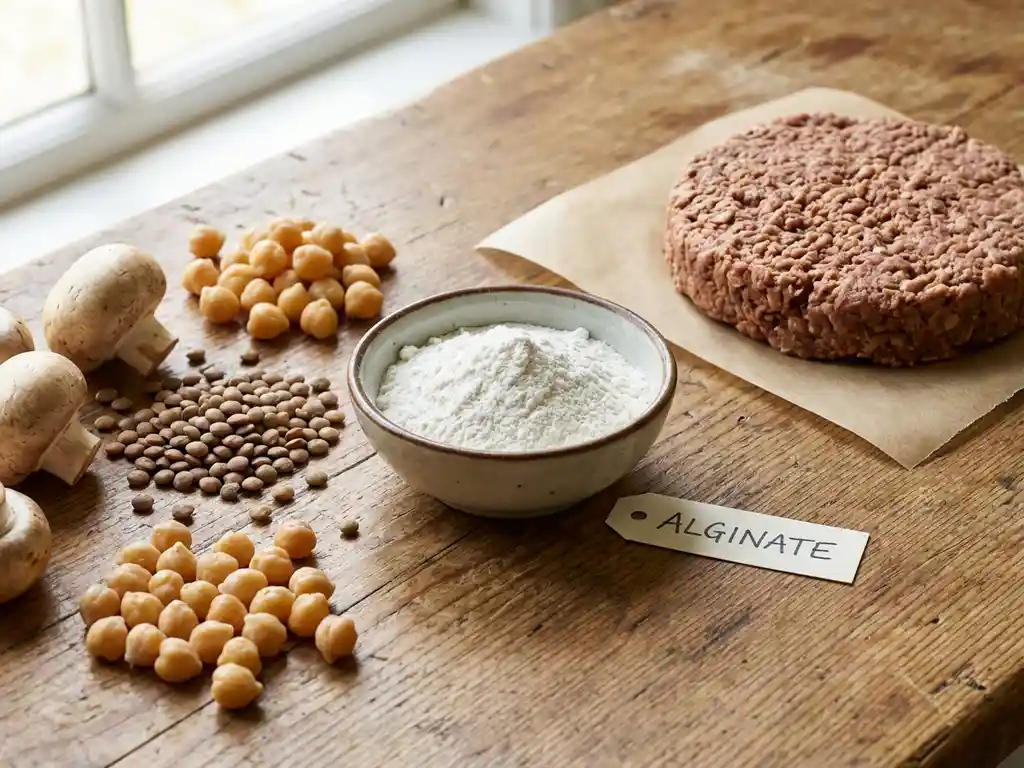
Alginate, a seaweed-derived compound, is gaining prominence in the food industry for its role in enhancing plant-based and meat-analog products. Its unique gel-forming properties make it a versatile ingredient in food production, particularly for improving texture and replacing traditional sausage casings. This article explores common questions about alginate’s applications and benefits.
What is alginate, and how is it used in food production?
Alginate is a natural polysaccharide extracted from brown seaweed, renowned for its gelling, thickening, and stabilizing properties. In food production, it is used to create a variety of textures and improve the structural integrity of plant-based and meat-analog products. Alginate’s ability to form firm gels makes it an ideal ingredient for developing products that mimic the texture of traditional animal-based foods, contributing to cost reduction in the food industry.
How does alginate enhance texture in plant-based foods?
Alginate enhances texture in plant-based foods by forming stable gels that improve mouthfeel and product consistency. When combined with calcium ions, alginate creates a firm yet flexible gel matrix that can replicate the bite and texture of meat. This is particularly beneficial in plant-based products, where achieving a desirable texture is essential for consumer acceptance and aligns with the theme of cost reduction by improving production efficiency.
What are the benefits of alginate in meat-analog products?
Alginate offers several benefits in meat-analog products by enhancing quality, stability, and shelf life. Its gel-forming ability helps maintain product integrity during cooking and storage while also providing a uniform texture. This results in meat analogs that not only resemble traditional meat in appearance but also retain their form and taste over time, thereby supporting cost-effective production.
How does alginate casing compare to traditional sausage casings?
Alginate casing offers several advantages over traditional animal-based casings, particularly in terms of sustainability and cost-effectiveness. Unlike natural or collagen casings, alginate casings are 100% plant-based, reducing the environmental impact of sausage production. They are also engineered for high-speed production lines, which can lower labor costs and minimize waste. Compared to collagen casing vs alginate casing, alginate provides a similar appearance and texture, making it a viable alternative for cost reduction.
How Vaess helps with alginate casing
At Vaess, we offer innovative solutions with our alginate casing technology, designed to meet the needs of modern food production:
- End-to-end solutions for alginate casing and sausage processing.
- High-speed, continuous co-extrusion lines for efficient production.
- Plant-based casing suitable for meat, plant-based, halal, and kosher applications.
- Reduced labor dependency and minimized production waste, supporting cost reduction strategies.
Explore how Vaess can enhance your sausage production processes with our state-of-the-art alginate technology, a perfect example of ‘food for tomorrow’.
In summary, alginate plays a crucial role in the development of plant-based and meat-analog products by offering textural improvements and sustainable alternatives to traditional casings. Vaess continues to lead in alginate casing sausage technology, providing innovative solutions that align with the demands of modern food production and cost reduction goals. For more information on how alginate can benefit your operations, consider reaching out to our team for expert guidance.
Gerelateerde artikelen
- How do you evaluate an alginate casing supplier's R&D capabilities for future product development?
- What are the red flags when evaluating a new alginate casing supplier for large-scale production?
- What is the extrusion process and how does it give alternative proteins a meat-like texture?
- What certifications and audit requirements should alginate casing suppliers meet for EU market access?
- How does alginate casing technology support product differentiation in premium segments?