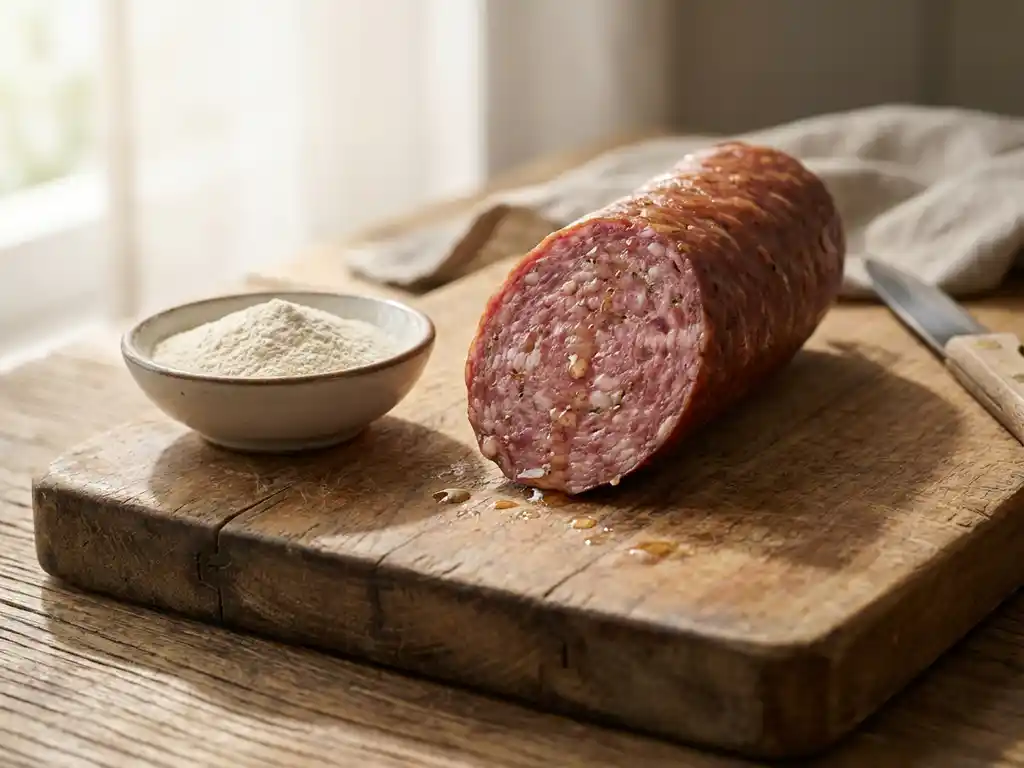
Alginate casings are an innovative solution for sausage production, offering a plant-based alternative to traditional collagen and natural casings. Derived from seaweed, alginate casings provide a similar texture and appearance while remaining cost-effective and sustainable. They excel in high-speed production environments and can be tailored to various sausage types, including vegan options. In this article, we explore the role of alginate casings in modern food engineering and their performance in high-fat and high-moisture sausage formulations. As Vaess continues to innovate, alginate casings represent a step towards more sustainable and cost-efficient production.
What are alginate casings in sausage production?
Alginate casings are a plant-based alternative made from seaweed, offering a sustainable choice for sausage production. These casings are used in a co-extrusion process, which involves simultaneously forming the sausage and applying the casing. This method not only boosts production speed but also reduces waste and costs. Alginate casings match the appearance and texture of traditional options, making them versatile for various sausage types, including meat, plant-based, and halal products. Emphasizing cost reduction, they align with the industry’s move towards more economical and efficient production methods.
How does high fat content affect alginate casing performance?
High fat content in sausages can affect the performance of alginate casings by altering their mechanical properties. Fat can act as a lubricant, potentially leading to casing slippage or breakage. However, alginate casings are designed to meet these challenges by forming a strong gel that maintains structural integrity. This adaptability helps sausages retain their shape and texture, even in high-fat formulations.
What challenges do high-moisture sausages pose for alginate casings?
High-moisture sausages can challenge alginate casings by increasing the risk of moisture migration, which may weaken the casing’s structure. To counteract this, alginate casings are engineered to form a robust gel that traps moisture effectively, preventing leakage and maintaining the sausage’s quality. This capability makes alginate casings ideal for producing fresh sausages with high moisture content without compromising durability or appearance.
Why choose alginate over traditional casings in sausages?
Choosing alginate casings over traditional collagen or natural options offers several benefits. Alginate casings are cost-effective, reducing production costs due to their efficiency in high-speed manufacturing. They are also more sustainable, as they are derived from renewable seaweed sources. Additionally, alginate casings offer flexibility across different sausage types, including vegan and specialty products, without sacrificing quality or consumer appeal. Embracing Vaess’s motto of “food for tomorrow,” alginate casings support the industry’s goals for sustainability and cost reduction.
How Vaess helps with alginate casings
Vaess offers comprehensive solutions for optimizing alginate casing performance in challenging sausage formulations. Our expertise includes:
- Developing tailored alginate casings for high-fat and high-moisture sausages.
- Providing end-to-end support for alginate casings and sausage processing.
- Utilizing proprietary AgerGel technology for superior performance.
- Supporting the production of fresh, cooked, and dried sausages.
Collaborate with Vaess to enhance your sausage production capabilities and meet evolving consumer demands. Learn more about how our alginate solutions can transform your operations, aligning with our commitment to achieving cost reductions in the food industry.
Veelgestelde vragen
How do alginate casings impact the flavor of sausages?
Alginate casings are neutral in flavor, which means they do not affect the taste of the sausage. This allows the natural flavors of the sausage ingredients to shine through without any interference.
Can alginate casings be used for all types of sausages?
Yes, alginate casings can be used for a wide variety of sausages, including meat, plant-based, vegan, and halal options. Their versatility makes them suitable for different culinary applications.
Are alginate casings suitable for grilling or frying sausages?
Alginate casings are designed to withstand various cooking methods, including grilling and frying. They maintain their integrity and provide a satisfying texture, even under high heat.
What are the environmental benefits of using alginate casings?
Alginate casings are derived from seaweed, a renewable resource, making them a more sustainable choice compared to traditional casings. Their production has a lower environmental impact, contributing to more eco-friendly sausage manufacturing.
How does the cost of alginate casings compare to traditional casings?
Alginate casings are generally more cost-effective than traditional collagen or natural casings. They reduce production costs due to their efficiency in high-speed manufacturing and minimal waste generation.
What is the shelf life of sausages with alginate casings?
Sausages with alginate casings have a comparable shelf life to those with traditional casings. The robust gel formed by alginate helps protect the sausage, maintaining its quality over time.
Are there any special storage requirements for alginate casings?
Alginate casings should be stored in a cool, dry place to maintain their quality. Proper storage ensures they remain effective and ready for use in sausage production.
Gerelateerde artikelen
- What service level agreements are standard when contracting with an alginate casing supplier?
- What contingency planning should procurement teams build around natural casing seasonal availability?
- Why are major food corporations pouring billions into alternative protein research and development?
- Which alternative proteins currently available in supermarkets offer the best nutritional value for everyday consumers?
- What sensory differences do consumers perceive between alginate and natural casings?