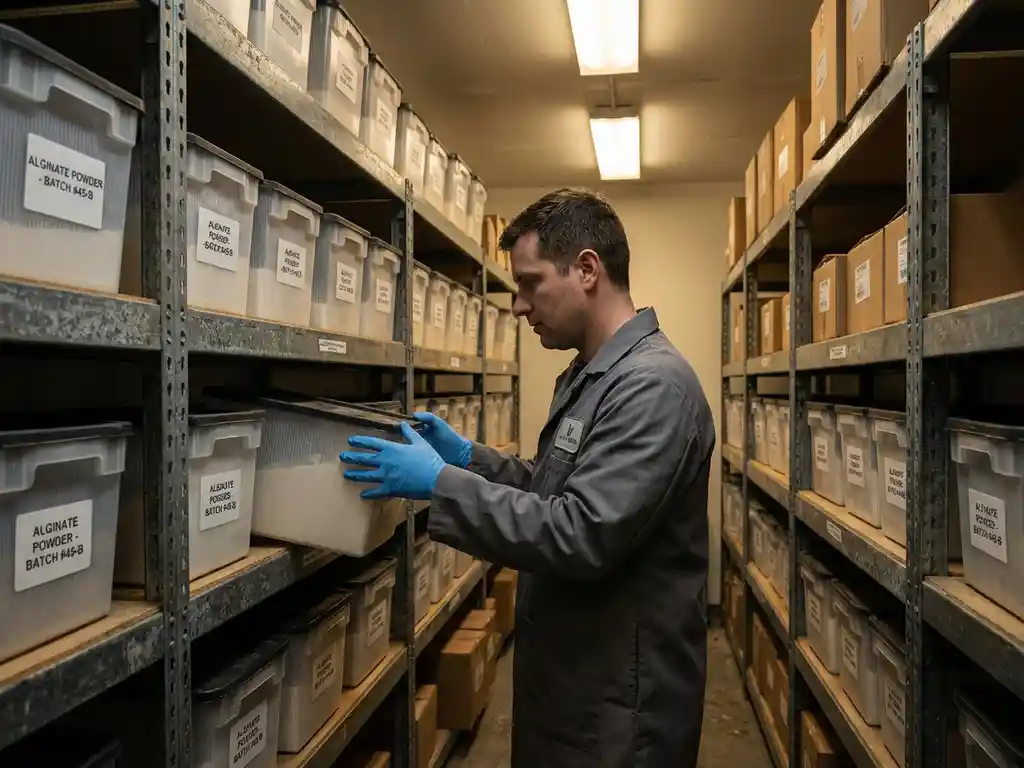
Alginate casing, a popular alternative to traditional sausage casings, requires specific storage and handling to maintain its quality and effectiveness. Optimal storage conditions are key to preserving alginate’s properties, while proper handling ensures safety and efficiency in production environments. This article explores best practices for storing and handling alginate, addresses common challenges, and explains how these factors affect production efficiency. Additionally, we’ll discuss how Vaess supports companies with innovative alginate solutions.
What are the optimal storage conditions for alginate?
Alginate should be stored in a cool, dry place, ideally between 15°C and 25°C (59°F and 77°F), with humidity levels maintained below 65%. It is crucial to use airtight packaging to prevent moisture absorption, which can compromise alginate’s quality. Proper storage ensures that alginate remains effective for its intended applications by preserving its gel-forming properties and ensuring consistent performance in sausage production.
To maintain alginate quality, it’s essential to monitor storage conditions regularly to ensure that temperature and humidity remain within the recommended ranges. This vigilance helps prevent degradation that could affect alginate’s effectiveness in production and aids in cost reduction by minimizing waste.
How should alginate be handled in a production environment?
In a production setting, alginate should be handled with care to prevent contamination and ensure safety. Workers should use gloves and masks to avoid direct contact, as alginate powders can be irritating if inhaled. Equipment such as mixers and extruders must be kept clean to prevent cross-contamination. Proper training on handling procedures is essential to maintain safety and product integrity.
Implementing stringent safety protocols not only protects workers but also enhances the quality of the final product, ensuring that the alginate casing maintains its structural integrity and desired properties.
What are the common challenges in storing and handling alginate?
Common challenges include moisture sensitivity and contamination risks. Alginate is highly absorbent, making it prone to clumping if exposed to moisture. This can be mitigated by using desiccant packs and ensuring airtight storage. Contamination can occur if alginate is handled with unclean equipment or if training is inadequate. Regular equipment cleaning and staff training are vital to overcoming these challenges.
By addressing these issues proactively, production facilities can minimize downtime and ensure that the alginate casing performs optimally, providing a reliable alternative to collagen casings. This approach contributes to cost reduction by enhancing process efficiency and reducing material waste.
How can alginate storage impact production efficiency?
Proper alginate storage directly influences production efficiency and product quality. When stored correctly, alginate retains its functional properties, enabling smooth and consistent extrusion processes. This reduces the likelihood of production delays or defects, ultimately leading to higher output and reduced waste.
Ensuring optimal storage conditions not only preserves alginate quality but also enhances the overall efficiency of the production line, making it an integral aspect of successful sausage manufacturing. This efficiency aligns with efforts towards cost reduction in the food industry.
How Vaess helps with alginate casing
Vaess provides comprehensive solutions for alginate casing by leveraging our expertise in alginate technology:
- Offers a plant-based casing solution as an alternative to traditional options.
- Supports high-speed production lines with continuous co-extrusion capabilities.
- Ensures quality and consistency across fresh, cooked, and dried sausages.
- Provides technical support and innovation through our Food Technology Centres.
To explore how Vaess can enhance your production processes with alginate casing solutions and contribute to cost reduction, embodying our “food for tomorrow” philosophy, contact us today.
Veelgestelde vragen
What are the benefits of using alginate casing over traditional casings?
Alginate casing offers several benefits over traditional casings, including being plant-based, which appeals to vegetarian and vegan consumers. It’s also cost-effective, allows for high-speed production lines, and provides consistent quality across various types of sausages.
Can alginate casing be used for all types of sausages?
Yes, alginate casing can be used for fresh, cooked, and dried sausages. It provides versatility in production and is designed to maintain quality and consistency across different sausage types.
How does alginate casing contribute to sustainability?
Alginate casing is derived from seaweed, making it a sustainable and eco-friendly option compared to animal-based casings. Its plant-based nature reduces reliance on animal products and supports sustainable manufacturing practices.
What should be done if alginate casing becomes clumpy due to moisture exposure?
If alginate becomes clumpy, it’s essential to discard the affected portion to prevent production issues. Ensure future storage is airtight and consider using desiccant packs to absorb any excess moisture.
How often should equipment be cleaned when working with alginate casing?
Equipment should be cleaned regularly, ideally after each production cycle, to prevent cross-contamination and ensure the integrity of the alginate casing. Regular cleaning is crucial for maintaining product quality.
Are there any special disposal considerations for alginate casing?
Alginate casing is biodegradable, which simplifies disposal compared to synthetic casings. However, it’s essential to follow local regulations regarding industrial waste disposal to ensure compliance.
What training is necessary for staff handling alginate casing?
Staff should be trained on the proper storage, handling, and safety protocols when working with alginate. This includes the use of protective gear, equipment cleaning procedures, and recognizing signs of contamination or moisture exposure.
Gerelateerde artikelen
- Which alternative proteins currently available in supermarkets offer the best nutritional value for everyday consumers?
- What quality control parameters should procurement set for incoming alginate batches?
- How does alginate support texture consistency across different protein sources?
- How does alginate fit into a broader ingredient optimization strategy for processed meats?
- How do alginate casings behave under retort and pasteurization conditions?