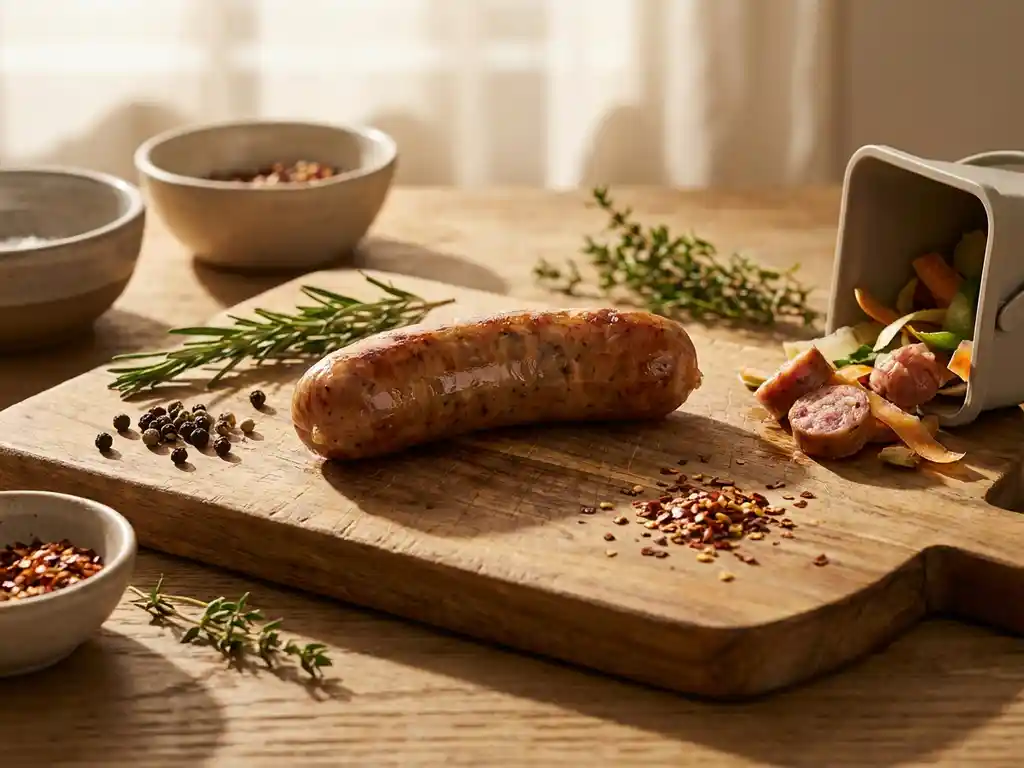
Alginate casings significantly enhance sausage production by improving yield and reducing waste. Unlike traditional collagen casings, alginate is derived from seaweed, providing a sustainable, plant-based alternative. This article explores how alginate casings work, their benefits, and how Vaess leads in this innovative technology while also focusing on cost reduction in the food industry.
What are alginate casings, and how do they work?
Alginate casings are made from alginate, a natural polymer extracted from seaweed. They serve as a plant-based alternative to traditional sausage casings, such as collagen or natural casings. Alginate casings are applied via co-extrusion during sausage production, forming a seamless, gel-like layer around the sausage meat. This layer sets quickly, providing a uniform appearance and a texture similar to traditional casings. Alginate casings are particularly valued for their versatility, as they are suitable for a wide range of sausage types, including fresh, cooked, and dried sausages.
How do alginate casings improve yield in sausage production?
Alginate casings enhance yield by reducing waste and optimizing production efficiency, a crucial aspect of cost reduction in the food industry. They eliminate the need for soaking or washing, which is required with natural casings, reducing preparation time and labor costs. Moreover, alginate casings provide consistent thickness, ensuring uniform product size and weight and minimizing material waste. This results in higher output and better utilization of raw materials, ultimately leading to cost savings and increased profitability for producers. The seamless integration of alginate casings into high-speed production lines further boosts operational efficiency.
What are the environmental benefits of using alginate casings?
Alginate casings offer significant environmental advantages by promoting sustainability and resource efficiency. Being plant-based, they reduce reliance on animal-derived materials, aligning with growing consumer demand for sustainable products. Alginate casings also contribute to reduced water use and waste generation in production, as they require no soaking or cleaning, unlike traditional casings. This not only saves water but also minimizes the environmental impact of sausage production. Using alginate casings can help producers meet sustainability goals and appeal to eco-conscious consumers.
How does Vaess’s alginate technology lead the industry?
Vaess stands at the forefront of alginate technology, leveraging its expertise to innovate and lead the market. With the world’s largest alginate gel production facility, Vaess offers comprehensive solutions for sausage processing. Our proprietary AgerGel range supports high-speed, continuous co-extrusion lines, ensuring seamless integration and exceptional product quality. Vaess’s commitment to alginate casing innovation extends across various applications, including meat, plant-based, halal, and kosher sausages, demonstrating our leadership and dedication to sustainable food engineering.
How Vaess helps with alginate casings
Vaess offers tailored alginate casing solutions, helping producers optimize their sausage production processes. Our services include:
- Comprehensive alginate casing solutions for diverse applications
- Support for high-speed production lines to enhance efficiency
- Expert guidance on reducing waste and improving yield, crucial for cost reduction
- Innovations aligned with sustainability goals
Contact Vaess to discover how our alginate casing solutions can transform your production processes and help you meet your operational goals, embodying our vision of ‘food for tomorrow’.
Gerelateerde artikelen
- What is the extrusion process and how does it give alternative proteins a meat-like texture?
- How is precision fermentation used to create proteins without the use of animals?
- How does switching to alginate casings affect production line efficiency?
- How does alginate casing technology affect throughput on high-speed filling lines?
- How does alginate co-extrusion affect line downtime compared to traditional casing systems?