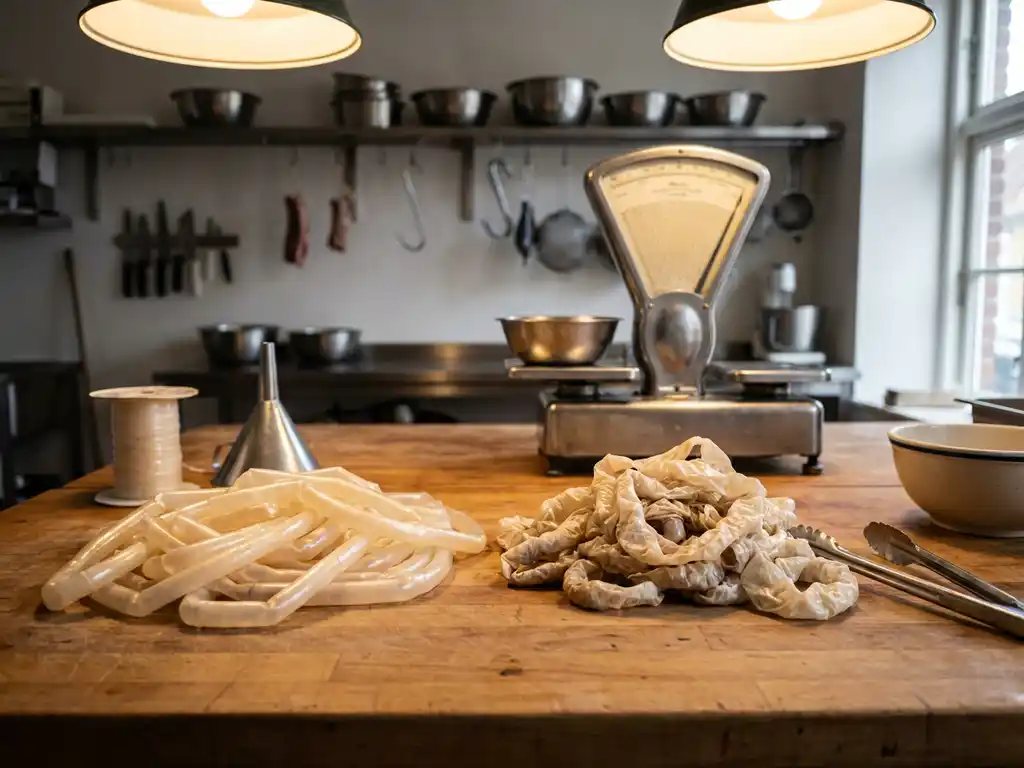
Alginate casings offer superior batch-to-batch consistency compared to natural casings for industrial buyers. This is primarily due to their uniform production and reduced variability. Natural casings, derived from animal intestines, can vary significantly due to biological factors, while alginate casings, made from seaweed, are engineered for precision. This consistency is crucial for industrial buyers focused on efficiency and quality control. In this article, we’ll explore the nuances of alginate and natural casings, factors affecting consistency, and how technology and innovation play a role.
Understanding alginate casings and natural casings
Alginate casings are plant-based casings derived from seaweed, offering a consistent and sustainable alternative to traditional animal-based casings. They are used extensively in sausage production due to their uniformity and ease of handling. Natural casings, on the other hand, are made from the intestines of animals, primarily pigs, sheep, and cattle, and are valued for their traditional texture and bite.
While natural casings have been used for centuries, alginate casings have gained popularity due to their ability to be mass-produced with consistent quality. This makes them particularly appealing for industrial-scale operations where predictability and efficiency are key. Additionally, alginate casings are suitable for a wide range of dietary requirements, including vegan, halal, and kosher, making them highly versatile.
Factors affecting batch-to-batch consistency
Batch-to-batch consistency is influenced by several factors, including raw materials, the production process, and quality control measures. For natural casings, biological variability is a significant factor, as they are subject to differences in animal size, species, and diet. This can lead to variations in thickness, diameter, and strength.
In contrast, alginate casings benefit from controlled production processes. Key factors ensuring their consistency include:
- Standardized raw materials: Seaweed sources are carefully selected and processed to ensure uniformity.
- Precision manufacturing: Advanced technology allows for precise control over casing thickness and strength.
- Robust quality control: Rigorous testing ensures each batch meets exact specifications.
These factors collectively contribute to the reliability of alginate casings, making them a preferred choice for manufacturers seeking consistency.
How do alginate and natural casings compare in consistency?
Alginate casings consistently outperform natural casings in terms of batch-to-batch uniformity. This is due to their engineered nature, which eliminates the biological variability found in natural casings. As a result, alginate casings provide a reliable option for manufacturers looking to maintain consistent product quality.
In practical terms, this means that alginate casings offer predictable performance across different production runs, minimizing the risk of defects and ensuring uniformity in the final product. Natural casings, with their inherent variability, may require additional sorting and selection processes, increasing labor and costs.
The role of technology in ensuring consistency
Technology plays a crucial role in ensuring the consistency of alginate casings. Automated production processes, precision engineering, and advanced quality control systems contribute to the high level of uniformity achieved with alginate casings.
Key technological advancements include:
- Co-extrusion systems: These systems allow for continuous production, enhancing efficiency and reducing variability.
- Real-time monitoring: Advanced sensors and data analytics ensure that each casing meets stringent quality standards.
- Innovative materials: Research and development efforts focus on improving the properties of alginate casings, further enhancing their consistency.
These technological innovations are essential for meeting the demands of modern food production, where consistency and quality are paramount.
How Vaess helps with batch consistency challenges
At Vaess, we specialize in overcoming batch consistency challenges with our advanced alginate casing solutions. Our approach includes:
- Utilizing our state-of-the-art AgerGel range for precise, plant-based casing production.
- Offering comprehensive support through our Food Technology Centres, providing testing and co-extrusion services.
- Collaborating with clients to tailor solutions that seamlessly integrate with existing operations.
Partner with Vaess to enhance your production efficiency and product quality. Explore our solutions to discover how we can support your needs in achieving consistent, high-quality outputs.
Veelgestelde vragen
What are the main benefits of using alginate casings over natural casings?
Alginate casings offer superior batch-to-batch consistency, are plant-based and suitable for various dietary requirements, and benefit from advanced manufacturing technologies that ensure uniformity and quality control.
Are alginate casings suitable for all types of sausages?
Yes, alginate casings are versatile and can be used for various types of sausages, including those requiring specific dietary considerations like vegan, halal, and kosher options.
How does the production process of alginate casings ensure their uniformity?
The production of alginate casings involves standardized raw materials, precision manufacturing, and robust quality control measures. These processes ensure uniform thickness, strength, and overall quality.
Can alginate casings be used in traditional sausage recipes?
Yes, while alginate casings offer a different texture compared to natural casings, they can be used in traditional recipes for those seeking consistency and dietary flexibility.
What role does technology play in the production of alginate casings?
Technology is crucial, with co-extrusion systems, real-time monitoring, and advanced materials research enhancing the consistency and quality of alginate casings.
How does Vaess support manufacturers in achieving casing consistency?
Vaess provides state-of-the-art alginate casing solutions, comprehensive support through Food Technology Centres, and collaborates with clients to tailor solutions that integrate with their operations.
Are there any limitations to using alginate casings compared to natural ones?
Alginate casings may differ in texture and bite from natural casings, which might not fulfill the preferences of all consumers seeking traditional casing characteristics.
Gerelateerde artikelen
- How do you structure a supplier scorecard for alginate casing vendors in a food manufacturing context?
- How do natural casing price fluctuations affect long-term sourcing strategies for sausage producers?
- How is precision fermentation used to create proteins without the use of animals?
- Why are regulatory frameworks struggling to keep pace with lab-grown meat and biofortified crop commercialisation?
- Are alginate casings compatible with halal and kosher production requirements?