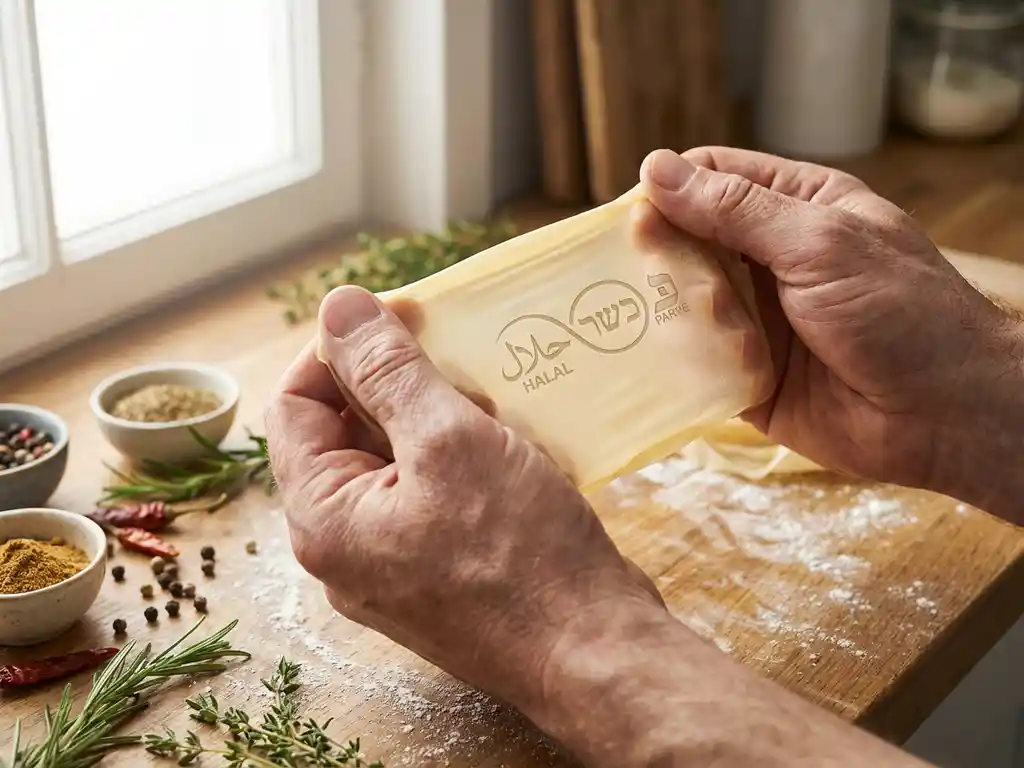
Alginate casings are plant-based alternatives to traditional sausage casings, compatible with halal and kosher production requirements. Made from seaweed, these casings are sustainable and free of animal-derived ingredients, making them suitable for a wide range of dietary needs. This article explores the manufacturing process for alginate casings, their halal and kosher certification, and the benefits they offer in food production.
What are alginate casings, and how are they made?
Alginate casings are made from alginate, a natural polysaccharide extracted from brown seaweed. This ingredient is transformed into a gel-like substance used to encase sausages. The process involves mixing alginate with water and a setting agent to form a cohesive gel that mimics the texture and appearance of traditional casings. The result is a versatile, sustainable casing suitable for various types of sausages.
Are alginate casings halal- and kosher-certified?
Yes, alginate casings can be certified as halal and kosher. These certifications require that the casings meet specific dietary laws, ensuring no cross-contamination with prohibited substances. Alginate casings, being plant-based and free of animal derivatives, align well with these standards. Certification involves inspection by authorized bodies to verify compliance with halal and kosher guidelines.
What makes alginate casings suitable for halal and kosher production?
Alginate casings are particularly suitable for halal and kosher production due to their plant-based composition. They do not contain animal-derived ingredients, which is a crucial factor for both halal and kosher compliance. In addition, these casings are produced in controlled environments to prevent contamination with non-compliant substances. This ensures that the final product maintains its integrity under religious dietary laws.
How does Vaess support halal and kosher production with alginate casings?
We ensure that our alginate casings are compatible with halal and kosher standards through rigorous quality control and certification processes. Our technology and production capabilities include:
- State-of-the-art facilities that prevent cross-contamination
- Regular audits and inspections to maintain certification standards
- Collaboration with certification bodies for ongoing compliance
- Customized solutions to meet specific customer requirements
Our commitment to quality and compliance makes us a reliable partner for halal and kosher food production. For more information or inquiries, please contact us.
Why choose alginate casings for food production?
Alginate casings offer several advantages in food production:
- Sustainability: Made from renewable seaweed, reducing environmental impact
- Cost-effectiveness: Lower production costs than traditional casings, aligning with the industry’s focus on cost reduction
- Operational efficiency: Suitable for high-speed, continuous production lines
- Versatility: Compatible with meat, plant-based, halal, and kosher applications
Choosing alginate casings improves production efficiency and cost-effectiveness while meeting diverse consumer needs. Whether you’re considering alginate vs. natural casing or collagen casing vs. alginate casing, alginate provides a modern, sustainable alternative for today’s food industry. Vaess is dedicated to delivering ‘food for tomorrow’ through innovative solutions.
Gerelateerde artikelen
- What is the extrusion process and how does it give alternative proteins a meat-like texture?
- How is machine learning transforming quality control and predictive formulation in modern food manufacturing?
- What are the supply chain risks of alginate compared to animal-derived casings?
- What competitive advantage does alginate casing technology offer over conventional casings?
- What environmental impact data is available for alginate vs. collagen casings?